I came across this odd little Swedish term recently and it was so intriguing, I dug a bit more and realised how close it was to something I was already very familiar with, Islam.
So, first, there are two loud voices about what we do with our stuff.
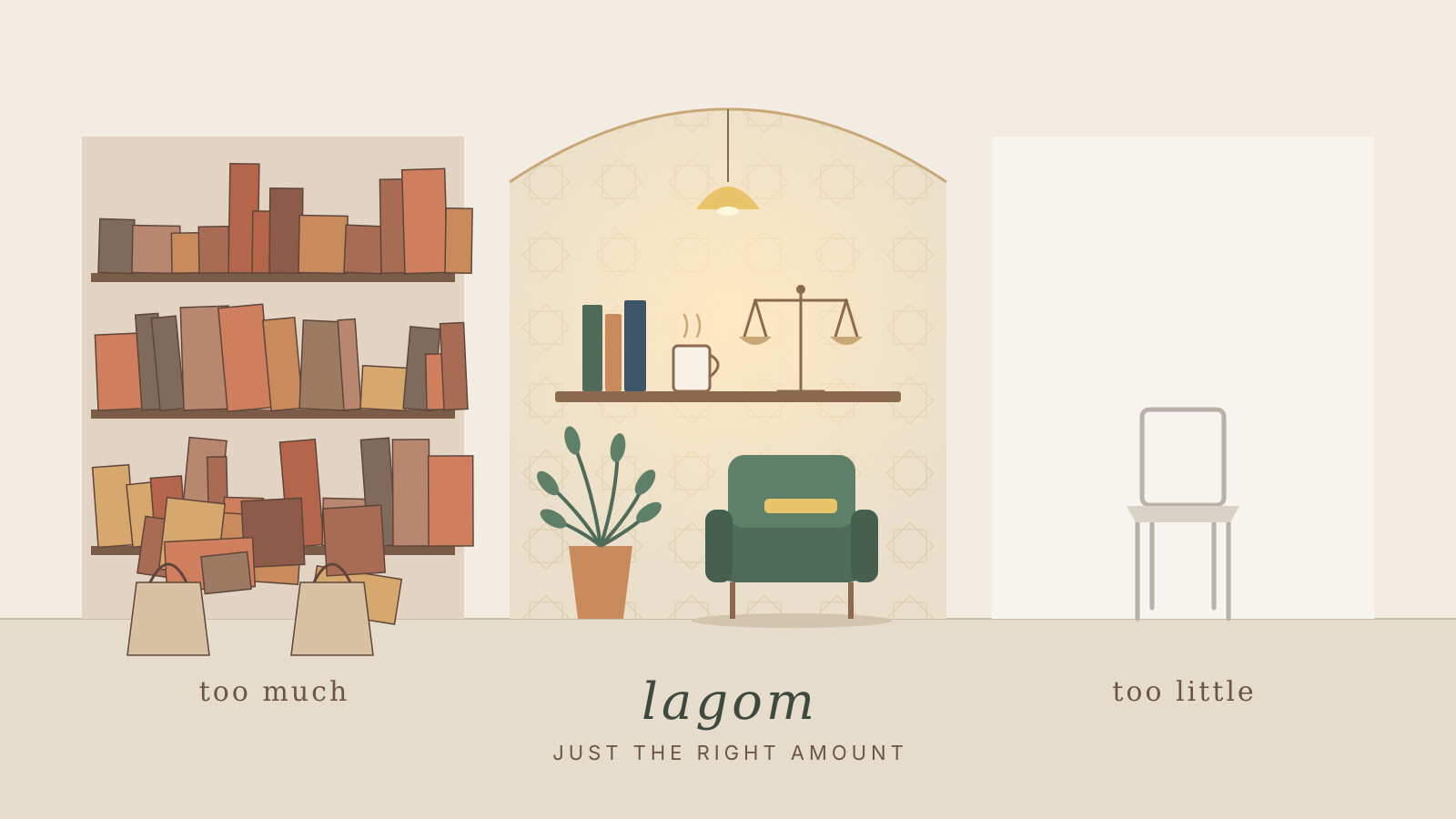
One, maximalist, says buy more. The basket that’s never quite empty, the next upgrade, the quiet promise that this one will finally be enough. The other, minimalist, says own less. The white room, the single chair, the wardrobe of 7 black T-shirts.
Both promise peace and both often deliver anxiety in one way or another. One leaves you with too much and enjoying it too little. The other leaves you with too little and still feeling like you’ve failed for not owning less… or the deeper feeling of being unfulfilled in your stark “nothing” room.
And so I found this term, “lagom”, a third way, and it’s older than both maximalism and minimalism. A Swedish name and an Islamic soul.
A word that started as law
The word is lagom (said LAH-gom). It means just the right amount. Not too much, not too little.
In terms of etymology, “Lagom” comes from lag, meaning law in the sense of “what’s laid down”. It’s an old grammar form meaning roughly “by the laws”.
Culturally, the story goes that Vikings were passing a horn of mead around the longhouse, each taking just enough so everyone got a share. Laget om, “around the team”. It’s lovely. It’s also not true. Linguists call it a folk etymology.
Anyway, the real history is less romantic but more useful. Lagom was never a rule in a book. It’s what a community agrees is sensible. The Swedes even have a proverb for it, lagom är bäst, the right amount is best. Our closest English version is probably “enough is as good as a feast”.
Then, around 2017, the rest of the world discovered it. After hygge, lagom was going to be the next big lifestyle trend, with books and cushions and candles to match. Think about that for a second… a word for “enough”, turned into something else to buy.
Swedes are honest about its shadow too. Some find lagom repressive, a quiet pressure not to stand out, not to be too good or too rich. Fair point. A measure set only by the group can become a cage. So the question can’t just be “what’s normal round here?” It has to be “what’s right?”, and especially… “what’s right for me?”
Islam already had a word for this
This is where it gets interesting for me.
The Quran describes Muslims as ummatan wasatan, a middle nation (2:143). The early commentators explained wasat as both just and best. Not lukewarm. Not the average. The balanced point between two extremes.
And just as lagom grew out of the word for law, wasat sits beside another word, mizan, the balance:
“And the heaven He raised and imposed the balance, that you not transgress within the balance. And establish weight in justice and do not make deficient the balance.” (Quran 55:7-9)
So both ideas tie “just enough” to a law. The difference is who sets it. Lagom’s measure comes from the community, which is why it can turn into pressure. The mizan comes from God, which makes it about justice, not fitting in.
The Quran applies this straight to money:
“And those who, when they spend, are neither extravagant nor stingy, but are moderate between the two.” (Quran 25:67)
The Arabic for that middle is qawaman, upright, firmly balanced. Islam also names the two ways we fall off it: israf, going beyond the limit, and tabdhir, squandering on what has no benefit.
But notice what it doesn’t say. It doesn’t say own nothing. “Take your adornment… eat and drink, but be not excessive” (Quran 7:31). You’re allowed beauty. You’re just not allowed to let it own you.
There’s an old Arabic saying you’ll hear a lot, “the best of matters is the middle”. It’s often passed around as a hadith, but scholars say it isn’t authentically from the Prophet ﷺ. It’s still a fair summary of everything above… and definitely comes from the essence of what Islam teaches.
The Prophet’s ﷺ economy of enough
What I find striking is how practical he ﷺ was about it.
On wealth: “Richness is not having many possessions. True richness is the richness of the soul.” (Bukhari 6446, Muslim 1051)
On comparison, which is basically the engine of consumerism: “Look at those below you and do not look at those above you, so that you do not belittle the blessings of Allah upon you.” (Muslim 2963)
On what’s actually enough: “Whoever wakes up secure in his home, healthy in his body, and with food for the day, it is as if the whole world has been given to him.” (Tirmidhi 2346)
That’s a low bar. A humbling one.
Underneath all of this is qana’ah, contentment with what you have. And this is where I think Islam goes deeper than any decluttering trend. Without qana’ah, every lagom line you draw gets redrawn the next time you scroll. With it, enough stops being a number and becomes a settled heart.
“Be in this world as a stranger or a wayfarer” (Bukhari 6416). A traveller carries what the journey needs. Not nothing, a traveller with no water doesn’t get very far. But not everything either.
Lagom is the traveller’s packing list.
So what does it look like on a Tuesday?
- Draw your lagom line. Decide what enough means for towels, mugs, cables, shoes. A vague guilt becomes a clear target.
- Sort by category, not by room. Cables live in four places. Gather them all, then sort into too little, lagom, too much.
- One in, one out. Something new comes in, something leaves. That’s how balance survives a birthday.
- Little and often. Fifteen minutes a season beats one brutal purge a year. “The deeds most beloved to Allah are those done consistently, even if they are small.” (Bukhari 6464)
- Give the excess away. This is the bit minimalism usually misses. It’s not just what leaves your home, it’s where it goes. Sadaqah turns a clear-out into something that counts.
Enough
I’m not a scholar and this isn’t a fatwa, it’s me trying to make sense of my own cupboards. But I keep coming back to this.
Not less for the sake of less. Not more for the sake of more. Just the right amount, held lightly and shared generously.
So, go ahead and own some nice things in moderation, but never let anything you own, own you.